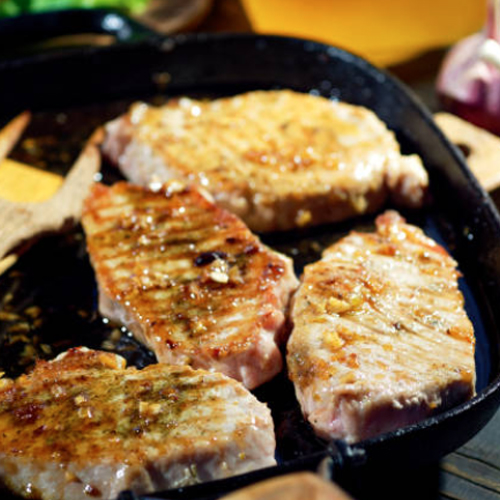
A pork chop can go from well browned to dry in the time it takes to set the table. The way to avoid that in cast iron is to buy a chop thick enough to sear without overcooking, turn it as it cooks, and check its center with a thermometer. The pan gives you a crust; the thermometer tells you when to stop.
This is a straightforward stovetop job. Allow about 10 minutes of hands-on prep, 8–14 minutes of cooking, and 5 minutes of resting. Salting the chops ahead adds at least 30 minutes, mostly unattended.
What you’ll need
Makes 2 chops; serves 2.
- 2 fresh pork rib or center-cut loin chops, bone-in or boneless, 1 to 1¼ inches thick, about 8–12 ounces each
- 1 teaspoon Diamond Crystal kosher salt, or ½ teaspoon fine salt
- ¼ teaspoon freshly ground black pepper
- 1 tablespoon neutral oil, such as canola or vegetable oil
- A 12-inch cast-iron skillet, tongs, paper towels, and an instant-read thermometer
- A clean plate or cutting board for resting the cooked chops
Buy chops of similar thickness so they finish at roughly the same time. A 1- to 1¼-inch chop leaves room to develop a crust before its center is done; a thin chop may cook through before it browns. Bone-in rib chops are a good choice, but boneless loin chops work with the same method. Check boneless chops earlier, and check bone-in chops in more than one spot near the bone. Rib and center-cut loin chops suit skillet cooking; shoulder or blade chops, which have more connective tissue, are better suited to slower cooking. For a different use of pork shoulder, pressure-cooker carnitas turn it tender before crisping the edges.
Ask the butcher to cut evenly thick chops if the case has only thin or uneven ones. There’s no reason to do that butchery yourself for a weeknight skillet dinner.
Cook the chops
-
Salt the pork. Sprinkle the measured salt over both sides and the fatty edges. If you have time, refrigerate the chops uncovered on a plate for 30 minutes to 24 hours; otherwise, cook them immediately after salting. Salt seasons the meat, while the uncovered rest helps its surface dry. Skip the advance salting if the package says the chops are “enhanced” or contain an added salt solution—salting those chops again can make them too salty.
-
Dry the chops. Blot both sides firmly with paper towels, then add the pepper. A damp surface steams before it browns. Keep raw pork and its juices away from ready-to-eat food, wash your hands after handling it, and use a clean plate—not the one that held raw chops—when they come out of the skillet.
-
Heat the skillet. Set the empty 12-inch cast-iron skillet over medium-high heat for about 3–5 minutes. Add the oil and swirl to coat the cooking surface. It should shimmer, not smoke heavily. Cast iron holds heat well, so give it time to warm up rather than turning the burner to its highest setting.
-
Sear the chops. Lay them in the skillet with space between them. Cook until the underside is golden brown, about 2–3 minutes, then turn them with tongs. Continue cooking, turning every 1–2 minutes so both sides brown without one side taking all the heat. If the oil smokes hard or the crust turns dark before the center is close to done, lower the burner to medium. If a chop has a thick fat edge, hold that edge against the pan briefly with the tongs to brown it. Frequent turning is useful here: it builds color while the meat cooks more evenly. For another example of how surface moisture affects a skillet crust, see the method for pan-searing scallops.
-
Check the temperature. Start checking a boneless chop after about 6 minutes total in the skillet and a bone-in chop after about 8 minutes. Slide the thermometer probe into the thickest part from the side, aiming for the center without touching bone or fat. Check each chop separately; for a bone-in chop, also check the meat close to the bone. Keep turning and checking at short intervals until the coolest reading reaches 145°F. Depending on thickness and stove heat, this may take roughly 8–14 minutes total. Color, firmness, and the clock cannot replace the thermometer: the safe minimum for whole pork chops is 145°F, followed by a rest of at least 3 minutes. Don’t remove a chop at 135–140°F on the assumption that resting will bring it to a safe temperature.
-
Rest the chops. Move each chop to the clean plate as soon as it reaches 145°F. Let it rest for 5 minutes before cutting. Heat continues to move inward after the chop leaves the skillet, so its temperature may rise further; that carryover is a reason to stop cooking at the measured minimum, not to leave the chop in the hot pan while you prepare a side dish. Spoon any resting juices over the sliced meat.
How to tell it worked—and what to change next time
The chops should have browned patches on both faces, a center that reached 145°F before leaving the pan, and juices on the resting plate. A little pink in the center can remain at that temperature. If the crust is pale but the center is done, the chops were likely damp, crowded, or put in a skillet that wasn’t hot enough. Next time, dry them thoroughly, heat the pan longer, or cook one at a time.
If the outside is very dark while the center still reads below 145°F, reduce the heat and keep turning until the center catches up. If the finished pork is dry, check whether the chops were thinner than an inch or stayed in the skillet after reaching temperature. The fix is a thicker chop and an earlier thermometer check, not a longer rest.
Refrigerate leftover pork within 2 hours, use it within 3–4 days, and reheat leftovers to 165°F. For a gentle texture, warm slices with a splash of water in a covered skillet and check their temperature rather than frying them a second time.